Showing posts with label Out of Content. Show all posts

Thursday, December 9, 2010

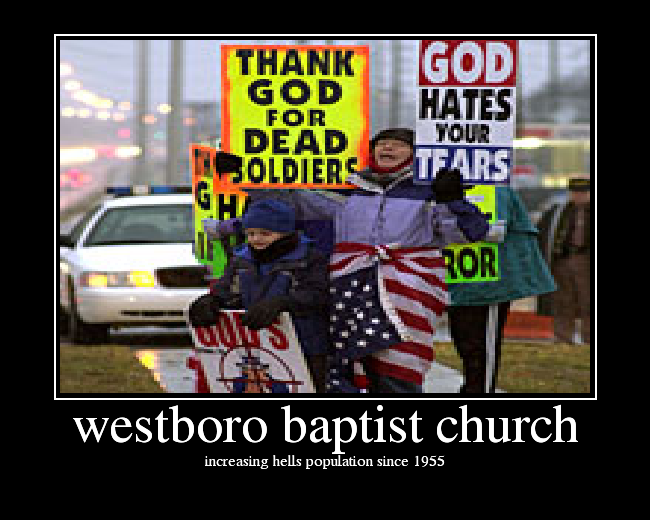
Westboro Baptist Church

Members of the Westboro Baptist Church, which is known for anti-homosexual protests at funerals, has announced on Thursday that they will picket Elizabeth Edwards‘ funeral on Saturday.

The anti-gay fundamentalist group, which is led by Rev. Fred Phelps, is most known for its protests at the funerals of military servicemen - though it has also picketed such events as theater productions and high school graduations.

In a statement released on the church's website -- the URL of which, www.godhatesfags.com, gives a pretty good sense of the group -- Westboro accused Edwards of "spewing blasphemy" and mounting a "smash-mouthed assault on His deity."

"Elizabeth Edwards & her faithless husband, John, lightly esteemed what they had. They coveted things that were not theirs - and presumptuously thought they could control God," the statement reads in part.

Edwards, an advocate of gay rights and same-sex marriage, died on Tuesday after a six-year battle with cancer.

According to the Washington Post, the Edenton Street United Methodist Church - which is hosting the services - said it was aware of the church's plan to protest but had not yet decided how to respond.

30 after officers said they witnessed him following members of Westboro Baptist Church in his white, Ford SUV after the members left their protest at ...

Fred Phelps' Westboro Baptist Church demonstrate during funeral services for Dr. George Tiller Saturday, June 6, 2009, at College Hill United Methodist ...

By SUSAN BERG “Ignore Westboro Baptist Church and they won't come back” was the message sent by law enforcement Wednesday evening at a town hall meeting, ...

The controversial Westboro Baptist Church, led by Reverend Fred Phelps and known for its anti-gay and anti-America messages, has scheduled a series of ...

(CNN) -- Members of the Westboro Baptist Church announced Thursday plans to picket Saturday's funeral for Elizabeth Edwards in Raleigh, North Carolina.
A Kansas-based church known for its high-profile protests of service members' funerals is planning to show up at the memorial service for the late Elizabeth Edwards, the group said Thursday.

Kansas-based Westboro Baptist Church will be dispatching members of its congregation to protest the funeral of Elizabeth Edwards this Saturday, CNN reports. The church has generated controversy with its confrontational and offensive ...

Escondido Bomb House

Escondido's "bomb house" was reduced to rubble late Thursday morning in a deliberately set fire that appeared to go off without a hitch.

At 10:55 a.m., authorities ignited the northwest Escondido house to render harmless what they say was a record-size cache of explosives.

It took about an hour to reduce the single-story house to ashes.

Carrie Ruano, who owns a home directly east of the house, said the fire was "spectacular."

"Part of me is sad that it got to this point ... that somebody is losing their property," she said. "The other part of me thinks this is spectacular."

After several weeks of planning, the San Diego sheriff's department, ATF , and other authorities began a controlled burn of the so-called "Bomb House" in ...

On Thursday, December 9 at 9:30am, emergency responders will initiate a burn operation on Via Scott in Escondido; the purpose is to destroy the property as ...

... today that the company met with Escondido, CA. homeowners concerned about the bomb house burning scheduled for Thursday morning, December 9th, 2010. ...

Still, to be on the safe side, if you smell smoke anywhere near the northwest Escondido-area home, which is just west of Interstate 15 and north of El Norte ...

After several weeks of planning, the San Diego sheriff's department, ATF , and other authorities began a controlled burn of the so-called "Bomb House" in Escondido. The home came under scrutiny on November 18, when landscaper Mario ...
Scores of authorities and explosives experts are burning the "Escondido bomb house" (image, left) in a heavily-populated residential area of Escondido, California. The Escondido bomb house was slated for it's planned-burn at 10:30 ...
You'll love this. A while back local law enforcement happened upon this house in Escondido, CA where for years apparently this guy named George Jakubec (not a Muslim, not a...

SAN DIEGO -- Originally set for Wednesday, 10News has learned the house of a man accused of making bombs and storing large amounts of ...

The torching of Escondido's "bomb house" appeared to go off without a hitch late Thursday morning.

Weather permitting, a North County rental home where a man allegedly built makeshift bombs and stored large amounts of explosive materials ...

Judge denies move to delay burning of 'bomb factory' house ... of the items found in the home at 1954 Via Scott in the unincorporated area of Escondido. ....


LeBron James South Beach home worth $9 million

LeBron James South Beach home worth $9 millionLeBron James buys a $9 million home in Coconut Grove, Florida for his family.

LeBron James’ South Beach home, a $9 million palace overlooking Biscayne Bay in Coconut Grove, Florida, will not leave the basketball player and his family wanting for luxuries and comfortable living.

According to Babble, the new home boasts “three fountains, room for two 60-foot yachts, six bedrooms and 8.5 bathrooms”, all within a total of 20,000 square feet.

That’s still less extravagant than some of the other homes James was looking at, including a property worth $50 million.

According to the Gather Celebs News Channel website, the NBA star made headlines over the summer when he left his old team, the Cleveland Cavaliers, to join the Miami Heat.

The luxurious South Beach home is expensive enough, but still cost James less than the residences of some of his popular new teammates with the Heat, according to The Washington Post. Chris Boch paid $12.5 million for his seven-bedroom home in Miami Beach, which is also the location of Dwayne Wade’s $10.6 million home.

The Sun-Sentinel has posted a photo gallery of LeBron James’ new home, leaving up to its viewers to decide whether it’s too much, not enough, or just right for a sportsman of his pedigree.

LeBron James' South Beach home, a $9 million palace overlooking Biscayne Bay in Coconut Grove, Florida, will not leave the basketball player and his family ...

... remained slightly more ambiguous until July 8, 2010, when Lebron James uttered the infamous words, “I'm going to take my talents to South Beach. ...

Local resident takes his talents to South Beach. Area fans express "... what's a stronger phrase for "blood-boiling, white-hot, screeching outrage"? ...

... and apparently James had a nasty run in with a wild pack of them while dining at a fancy restaurant on South Beach. After the Heat's home victory ...

LeBron James South Beach home pictures: Wow, is his new $9 million South Beach house over the top?
Lebron james south beach home $ 9000000 home of LeBron view Biscayne Bay in Coconut Grove, Miami, Florida. The house is 12.178 square meters in 3590 Crystal View Court. It offers views of Biscayne Bay, a home theater and guest house, ...
LeBron James lately purchased a lavish $9 million south Beach Home for his family, and we found it really awesome. James, hit headlines this summer for his.


Panama Canal Closed Due To Flooding

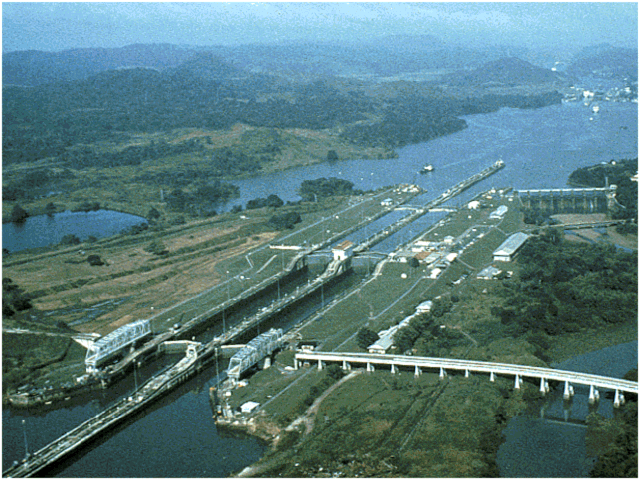
Panama Canal Closed Due To Flooding - Heavy rains and flooding Wednesday prompted the closing of the Panama Canal for only the third time in its storied 96-year history.

Officials closed the canal around noon and were hoping to reopen it by Wednesday evening, Fernando Lemos, spokesman for the Panama Canal administrator, said.

"The situation might get better in the next few hours," Lemos said, "but there is no exact time as to when the canal will open again."

Lemos said most of the heavy rain was in the Chagres River area, causing water behind the Gatun Dam -- which creates Lake Gatun, a significant part of the canal -- to rise.

The last time the canal closed was in 1989, after the United States invaded Panama to topple strongman Manuel Noriega. Landslides forced the canal to close for several months from late 1915 to mid-1916, just months after it opened.

The 48-mile canal is a key conduit for shipping between the Pacific and Atlantic oceans.
The canal was built from 1904 to 1914 by the United States, which had sole control over the channel across the Panamanian isthmus until 1979.

Then, after 20 years of joint U.S.-Panama control, the Panamanian government assumed administration on December 31, 1999.

By the CNN Wire Staff (CNN) -- The Panama Canal reopened Thursday after heavy rains and flooding prompted the its closing for only the third time in its ...

... Washington for the $75 million in federal dollars still needed to deepen the port by 2014, when large vessels begin going through the Panama Canal. ...

State officials want to deepen the second-largest port on the East Coast by six feet, giving it a 48-foot depth, around the time the Panama Canal finishes ...

It started for me on January 3rd in Mazatlan, Mexico and ended with the transiting of the Panama Canal on Thanksgiving day. During those 11 months I have ...

The Panama Canal is the shortcut between the Atlantic and the Pacific oceans. As the Earth's climate changes, the canal will face changes, too. It depends on rain, not seawater, to fill its locks, and changes in rainfall might mean the ...
Flooding forced the closure of the Panama Canal Wednesday for the first time in 21 years and heavy rains were being blamed for at least eight deaths in the Central American country. More than a thousand people in Panama were evacuated ...
Panama Canal Closed Due To Heavy Rains. December 8, 2010. by dekerivers. You do not see this every day. Traffic through the Panama Canal – which connects the Pacific and Atlantic oceans – has been temporarily suspended because of heavy ...


The Panama Canal

The Panama Canal is a 77 km (48 mi) ship canal in Panama that joins the Atlantic Ocean and the Pacific Ocean and is a key conduit for international maritime trade. Built from 1904 to 1914, annual traffic has risen from about 1,000 ships in the canal's early days to 14,702 vessels in 2008, measuring a total 309.6 million Panama Canal/Universal Measurement System (PC/UMS) tons.

One of the largest and most difficult engineering projects ever undertaken, the canal had an enormous impact on shipping between the two oceans, replacing the long and treacherous route via the Drake Passage and Cape Horn at the southernmost tip of South America. A ship sailing from New York to San Francisco via the canal travels 9,500 km (5,900 mi), well under half the 22,500 km (14,000 mi) route around Cape Horn.

The concept of a canal near Panama dates to the early 16th century. The first attempt to construct a canal began in 1880 under French leadership, but was abandoned after 21,900 workers died, largely from disease (particularly malaria and yellow fever) and landslides. The United States launched a second effort, incurring a further 5,600 deaths but succeeding in opening the canal in 1914. The U.S. controlled the canal and the Canal Zone surrounding it until the 1977 Torrijos–Carter Treaties provided for the transition of control to Panama. From 1979 to 1999 the canal was under joint U.S.–Panamanian administration, and from 31 December 1999 command of the waterway was assumed by the Panama Canal Authority, an agency of the Panamanian government.

While the Pacific Ocean is west of the isthmus and the Atlantic to the east, the 8- to 10-hour journey through the canal from the Pacific to the Atlantic is one from southeast to northwest. This is a result of the isthmus's "curving back on itself" in the region of the canal. The Bridge of the Americas at the Pacific end is about a third of a degree of longitude east of the end near Colon on the Atlantic.

The maximum size of vessel that can use the canal is known as Panamax. A Panamax cargo ship will typically have a DWT of 65,000-80,000 tonnes, but its actual cargo will be restricted to about 52,500 tonnes because of draft restrictions in the canal. The longest ship ever to transit was the San Juan Prospector, now Marcona Prospector, an ore-bulk-oil carrier that is 973 ft (296.57 m) long, with a beam of 106 ft (32.31 m).

History

Early proposal

The earliest mention of a canal across the Isthmus of Panama dates to 1534, when Charles V, Holy Roman Emperor and King of Spain ordered a survey for a route through Panama that would ease the voyage for ships traveling to and from Spain and Peru, as well as give the Spanish a tactical military edge over the Portuguese. During his expedition of 1788–1793, Alessandro Malaspina demonstrated the feasibility of a canal and outlined plans for its construction. Given the strategic situation of Panama and its narrow isthmus separating two great oceans, other forms of trade links were attempted over the years. The ill-fated Darien scheme was an attempt launched by the Kingdom of Scotland in 1698 to set up an overland trade route, but was defeated by the generally inhospitable conditions, and abandoned in July of 1699. Finally, the Panama Railway was built across the isthmus, opening in 1855. This overland link became a vital piece of infrastructure, greatly facilitating trade and largely determining the later canal route.

Also in 1855, William Kennish, a Manx-born engineer in the employ of the United States government, surveyed and issued a report on a route for a proposed Panama Canal. His report was published in a book entitled The Practicality and Importance of a Ship Canal to Connect the Atlantic and Pacific Oceans.
French construction attempt

An all-water route between the oceans was still seen as the ideal solution, and the idea of a canal was enhanced by the success of the Suez Canal. The French, under Ferdinand de Lesseps, began construction on a sea-level canal (i.e., without locks) through what was then Colombia's province of Panama, on January 1, 1880. The French began work in a rush, with insufficient prior study of the geology and hydrology of the region. Excavation was conducted at such a steep angle that, in some years, rain-induced landslides poured nearly as much material into the canal as had been removed. In addition, disease, particularly malaria and yellow fever, sickened and killed vast numbers of employees, ranging from laborers to top directors of the French company. Public health measures were ineffective because the role of the mosquito as a disease vector was then unknown. These conditions made it impossible to maintain an experienced work force as fearful technical employees quickly returned to France. Even the hospitals contributed to the problem, unwittingly providing breeding places for mosquitoes inside the unscreened wards. Actual conditions were hushed up in France to avoid recruitment problems. In 1893, after a great deal of work, the French scheme was abandoned due to disease and the sheer difficulty of building a sea-level canal, as well as lack of French field experience, such as with downpours that caused steel equipment to rust. The high toll from disease was one of the major factors in the failure; as many as 22,000 workers were estimated to have died during the main period of French construction (1881–1889).

Beyond the hygienic and technical difficulties, financial mismanagement and political corruption also contributed to the French failure.

U.S. construction

At this time, various interests in the United States were also expressing interest in building a canal across the isthmus, with some favouring a route across Nicaragua (see Nicaragua Canal and Ecocanal) and others advocating the purchase of the French interests in Panama. Eventually, in June 1902, the U.S. Senate voted in favor of pursuing the Panamanian option, provided the necessary rights could be obtained. (It is claimed that the vote was swayed by William Nelson Cromwell.)

On January 22, 1903, the Hay-Herran Treaty was signed by United States Secretary of State John M. Hay and Dr. Tomás Herrán of Colombia. It would have granted the United States a renewable lease in perpetuity from Colombia on the land proposed for the canal. This is often misinterpreted as the "99-year lease" due to misleading wording included in article 22 of the agreement that refers to property within the land but does not pertain to the control of the canal and the right for the United States to renew the lease indefinitely. It was ratified by the United States Senate on March 14, 1903, but the Senate of Colombia did not ratify the treaty. Philippe Bunau-Varilla, chief engineer of the French canal company, told Roosevelt and Hay of a possible revolt and hoped that the U.S. would support it with troops and money. President of the United States Theodore Roosevelt changed tactics, promising support for Panama's intermittent separatist movement. On November 2, 1903, U.S. warships blocked sealanes for Colombian troops from coming to put down the revolt, while dense jungles blocked land routes. Panama achieved independence on November 3, 1903 when the United States sent naval forces to encourage Colombia's surrender of the region. The United States quickly recognized them. Also, on November 6, 1903, Phillipe Bunau-Varilla, Panama's ambassador to the United States, signed the Hay-Bunau Varilla Treaty, granting rights to the United States to build and indefinitely administer the Panama Canal. Although Bunau-Varilla was serving as Panama's ambassador, he was a French citizen and was not authorized to sign treaties on behalf of Panama without Panamanian review.[citation needed] This treaty would later become a contentious diplomatic issue between the two countries.

The United States, under President Theodore Roosevelt, bought out the French equipment and excavations for US$40 million and began work on May 4, 1904. The United States paid Colombia $25,000,000 in 1921, seven years after completion of the canal, for redress of President Roosevelt's role in the creation of Panama, and Colombia recognized Panama under the terms of the Thomson-Urrutia Treaty.

John Frank Stevens, Chief Engineer from 1905 to 1907, argued the case against a sea-level canal like the French had tried to build and convinced Theodore Roosevelt of the necessity of a canal built with dams and locks. Stevens' primary achievement in Panama was in building the infrastructure necessary to complete the canal. He rebuilt the Panama Railway and devised a system for disposing of soil from the excavations by rail. He also built proper housing for canal workers and oversaw investment in extensive sanitation and mosquito-control programmes that eliminated disease from the area — particularly malaria and yellow fever, the vector of which had been identified as the mosquito by Cuban physician and scientist Dr. Carlos Finlay in 1881. Finlay's theory and investigative work had recently been confirmed by Dr. Walter Reed while in Cuba with U.S. Army motivation during the Spanish-American War (see also Health measures during the construction of the Panama Canal).

With the diseases under control, and after significant work on preparing the infrastructure, construction of an elevated canal with locks began in earnest and was finally possible. The Americans also gradually replaced the old French equipment with machinery designed for a larger scale of work (such as the giant hydraulic crushers supplied by the Joshua Hendy Iron Works) to quicken the pace of construction. President Roosevelt had the former French machinery minted into medals for all workers who spent at least two years on the construction to commemorate their contribution to the building of the canal. These medals featured Roosevelt's likeness on the front, the name of the recipient on one side, and the worker's years of service, as well as a picture of the Culebra Cut on the back.

In 1907 Roosevelt appointed George Washington Goethals as Chief Engineer of the Panama Canal. Ellicott Dredges, a Baltimore, MD, USA company formerly known as the Ellicott Machine Company, built the cutter dredges used in construction of the Panama Canal. The first machine delivered was a steam-driven, 900 hp (670 kW), 20-inch dredge. In 1941, Ellicott Dredges also built the dredge MINDI, a 10,000 hp (7,500 kW), 28-inch cutter suction dredge still operating in the Panama Canal.

The building of the canal was completed in 1914, two years ahead of the target date of June 1, 1916. The canal was formally opened on August 15, 1914 with the passage of the cargo ship SS Ancon. Coincidentally, this was also the same month that fighting in World War I (the Great War) began in Europe. The advances in hygiene resulted in a relatively low death toll during the American construction; still, 5,609 workers died during this period (1904–1914). This brought the total death toll for the construction of the canal to around 27,500.

Later developments

By the 1930s it was seen that water supply would be an issue for the canal; this prompted the building of the Madden Dam across the Chagres River above Gatun Lake. The dam, completed in 1935, created Madden Lake (later Alajuela Lake), which acts as additional water storage for the canal. In 1939, construction began on a further major improvement: a new set of locks for the canal, large enough to carry the larger warships which the United States was building at the time and had planned to continue building. The work proceeded for several years, and significant excavation was carried out on the new approach channels, but the project was canceled after World War II.

After the war, U.S. control of the canal and the Canal Zone surrounding it became contentious as relations between Panama and the U.S. became increasingly tense. Many Panamanians felt that the Canal Zone rightfully belonged to Panama; student protests were met by the fencing in of the zone and an increased military presence. The unrest culminated in riots in which approximately 20 Panamanians and 3–5 U.S. soldiers were killed on Martyr's Day, January 9, 1964. Negotiations toward a new settlement began in 1974, and resulted in the Torrijos-Carter Treaties. Signed by President of the United States Jimmy Carter and Omar Torrijos of Panama on September 7, 1977, this mobilized the process of granting the Panamanians free control of the canal so long as Panama signed a treaty guaranteeing the permanent neutrality of the canal. The treaty led to full Panamanian control effective at noon on December 31, 1999, and the Panama Canal Authority (ACP) assumed command of the waterway.

Before this handover, the government of Panama held an international bid to negotiate a 25-year contract for operation of the container shipping ports located at the canal’s Atlantic and Pacific outlets. The contract was not affiliated with the ACP or Panama Canal operations and was won by the firm Hutchison Whampoa, a Hong Kong-based shipping concern whose owner is Li Ka Shing.

Layout

The canal consists of artificial lakes, several improved and artificial channels, and three sets of locks. An additional artificial lake, Alajuela Lake (known during the American era as Madden Lake), acts as a reservoir for the canal. The layout of the canal as seen by a ship passing from the Pacific end to the Atlantic is as follows:

* From the buoyed entrance channel in the Gulf of Panama (Pacific side), ships travel 13.2 km (8.2 mi) up the channel to the Miraflores locks, passing under the Bridge of the Americas.
* The two-stage Miraflores lock system, including the approach wall, is 1.7 km (1.1 mi) long, with a total lift of 16.5 meters (54 ft) at mid-tide.
* The artificial Miraflores Lake is the next stage, 1.7 km (1.0 mi) long, and 16.5 meters (54 ft) above sea level.
* The single-stage Pedro Miguel lock, which is 1.4 km (0.8 mi) long, is the last part of the ascent with a lift of 9.5 meters (31 ft) up to the main level of the canal.
* The Gaillard (Culebra) Cut slices 12.6 km (7.8 mi) through the continental divide at an altitude of 26 meters (85 ft), and passes under the Centennial Bridge.
* The Chagres River (Río Chagres), a natural waterway enhanced by the damming of Lake Gatún, runs west about 8.5 km (5.3 mi), merging into Lake Gatun.
* Gatun Lake, an artificial lake formed by the building of the Gatun Dam, carries vessels 24.2 km (15.0 mi) across the isthmus.
* The Gatún locks, a three-stage flight of locks 1.9 km (1.2 mi) long, drop ships back down to sea level.
* A 3.2 km (2.0 mi) channel forms the approach to the locks from the Atlantic side.
* Limón Bay (Bahía Limón), a huge natural harbour, provides an anchorage for some ships awaiting passage, and runs 8.7 km (5.4 mi) to the outer breakwater.

Thus, the total length of the canal is 80 km (50 mi).

Columbia University Drug Bust

Related searches:
columbia drug bust, columbia university

The five Columbia students arrested in yesterday's campus drug bust pleaded not guilty to charges in court.

Harrison David, Chris Coles, Jose Perez (alias Stephan Vincenzo) and Adam Klein, all 20, along with Michael Wymbs, 22, have been charged with selling LSD, pot, cocaine, Adderall and MDMA, according to police.

Their arrests were the culmination of a five-month undercover sting, during which police purchased $11,000 worth of drugs from the students out of Columbia fraternity houses and dorms.

Amid the ongoing investigation, more details about the charged students have emerged. According to the Columbia Daily Spectator, Chris Coles told police that he sold drugs to "pay tuition." Harrison David had earlier told a detective that he participated in the illegal trade because his father would not pay for school.

Jose Perez is a prestigious Gates Millenium Scholar and, according to Bloomberg, has "limited financial ability." Bloomberg also reports that Michael Wymbs had a previously clean record and a 3.5 GPA. He worked one summer as a cancer research biostatician and is in the midst of applying to graduate school.

Different bail amounts were set for each student, the highest being for Harrison David at $75,000. According to the Spectator, only Michael Wymbs was prepared to post his bail, set at $25,000; the other students were scheduled to be taken to Rikers Island last night.

... and snared in what authorities say is the largest college drug bust in New York City. Harrison David, 20, a junior at prestgious Columbia University, ...

By Leslie Albrecht MORNINGSIDE HEIGHTS — As five Columbia University students waited to be bailed out of jail Wednesday on charges they ran a frat house ...

Cowen was taken to the University of Missouri Hospital and Clinics in Columbia with critical injuries. Cowen is charged with felony possession of a ...

Daily Caller
- Dec 08, 2010
- 21 hours ago
By TAMER EL-GHOBASHY - The Wall Street Journal | Published: 5:45 AM 12/08/2010 Five Columbia University students have been snared in an undercover drug ...

The five students who were arrested Tuesday morning as part of the Columbia University drug bust said they sold drugs to pay for schooling.
Posted from The Citrus Report This isn't a Stussy ad. This is four of the five Students from Columbia University who were arrested yesterday in what the Wall Street Journal said was the ” biggest drug bust on a college campus in recent ...
Columbia University Drug Bust, Five students: Chris Coles, David Harrison, Adam Klein, Jose Perez and Michael Wymbs were arrested yesterday in one of the largest drug seizures infiltration in the history of New York. ...


Tuesday, December 7, 2010

Politicians, advisers mourn Elizabeth Edwards

The Associated Press

RALEIGH, N.C. -- Reaction to the death of Elizabeth Edwards, who died Tuesday at age 61:

- President Barack Obama:

"Michelle and I were deeply saddened to learn of the passing of Elizabeth Edwards. This afternoon I spoke to Cate Edwards and John Edwards, and offered our family's condolences. I came to know and admire Elizabeth over the course of the presidential campaign. She was a tenacious advocate for fixing our health care system and fighting poverty, and our country has benefited from the voice she gave to the cause of building a society that lifts up all those left behind. In her life, Elizabeth Edwards knew tragedy and pain. Many others would have turned inward; many others in the face of such adversity would have given up. But through all that she endured, Elizabeth revealed a kind of fortitude and grace that will long remain a source of inspiration. Our thoughts and prayers are with her family and friends."

- Vice President Joe Biden:

"Elizabeth Edwards fought a brave battle against a terrible, ravaging disease that takes too many lives every day. She was an inspiration to all who knew her, and to those who felt they knew her."

- Gov. Beverly Perdue:

"I was saddened to learn of the death of Elizabeth Edwards. North Carolina has lost one of our smartest and most resilient women. My heart goes out to her family."

- U.S. Sen. Richard Burr:

"She was a passionate advocate for issues she believed in and a caring and loving mother. Her legacy should serve as an inspiration to all of us. Her life was not without tragedy and adversity, yet through it all she fought for her family and faced every challenge with courage, poise, and grace."

- U.S. Sen. Kay Hagan:

"She was a dedicated mother and a passionate advocate for cancer research and health care causes. During her remarkable life, Elizabeth always carried herself with dignity. She used her battle with breast cancer to raise cancer awareness and create change. She faced her battle in the public eye, and I very much admired her strength and courage."

- Former President Bill Clinton:

"With the passing of Elizabeth Edwards, America has lost a symbol of strength, hope, and humanity, a tireless advocate for health care for all Americans, and determined crusader for cancer cures. Her children have lost a loving mother, her friends a wise counselor."

- Dr. Otis W. Brawley, chief medical officer of the American Cancer Society:

"We can be grateful to Mrs. Edwards. Her decisions and open discussion of them bring an awareness that is good for all of us. Her presence will be missed, but her impact will live on forever."

- Democratic campaign strategist Joe Trippi:

"She was out to live every single day. She was going to live every single one of them with all the energy and grit that she could. That's a big lesson that her life could teach all of us."

- Democratic National Committee Chairman Tim Kaine:

"Elizabeth was a woman of firm convictions and strong principles, and she was an inspiration not only to members of the Democratic Party but to countless Americans of all backgrounds."


On December 6, 2010, Edwards' family announced that she would stop cancer treatment after her doctors advised her that further treatment would be unproductive, the cancer having metastasized to her liver. She had been advised she had several weeks to live. Her family members, including her estranged husband John, were with her. She posted her last message on Facebook:

“ You all know that I have been sustained throughout my life by three saving graces – my family, my friends, and a faith in the power of resilience and hope. These graces have carried me through difficult times and they have brought more joy to the good times than I ever could have imagined. The days of our lives, for all of us, are numbered. We know that. And, yes, there are certainly times when we aren't able to muster as much strength and patience as we would like. It's called being human.

But I have found that in the simple act of living with hope, and in the daily effort to have a positive impact in the world, the days I do have are made all the more meaningful and precious. And for that I am grateful. It isn't possible to put into words the love and gratitude I feel to everyone who has and continues to support and inspire me every day. To you I simply say: you know. ”

—Elizabeth Edwards

Edwards died of metastatic breast cancer on Tuesday, December 7, 2010, at home in Chapel Hill, surrounded by friends and family.

Read more about metastatic breast cancer

Elizabeth Edwards Biography

Elizabeth Anania Edwards (born Mary Elizabeth Anania) (July 3, 1949 – December 7, 2010) was an attorney and a best-selling author. At the time of her death, she was separated from her husband John Edwards, the former U.S. Senator from North Carolina who was the 2004 United States Democratic vice-presidential nominee.

Family and early life

Elizabeth Anania, the daughter of Elizabeth and Vincent Anania (1920–2008), grew up in a military family, moving many times and never having a hometown, as her father, a United States Navy pilot, was transfered from military base to military base during her childhood and adolescence. For part of her childhood she lived in Japan, where her father was stationed. She relates in Resilience that one of the hardest of the many relocations that she went through was having to move during her senior year of high school.[citation needed] She graduated from the Francis C. Hammond High School in Alexandria, Virginia, then attended Mary Washington College in Fredericksburg, Virginia. She then transferred to the University of North Carolina at Chapel Hill, from which she received her bachelor's degree. After three years of postgraduate studies in English at UNC, she entered UNC's School of Law and earned a J.D.. She met John Edwards when they were both law students at UNC. They married on July 30, 1977.

Elizabeth was the mother of four children with her husband John: Wade, Catharine, Emma Claire, and Jack. Wade was killed in April 1996 when he lost control of his Jeep while driving from his Raleigh home to the family's beach house in the private gated community of Figure Eight Island, near Wilmington. Three weeks before his death, Wade Edwards was honored by First Lady Hillary Rodham Clinton at the White House as one of the 10 finalists in an essay contest sponsored by the National Endowment for the Humanities and the Voice of America. Wade, accompanied by his parents and sister, met North Carolina Senator Jesse Helms. After Wade died, Helms entered his essay and his obituary into the Congressional Record.

Following Wade's death, the Edwardses decided to have more children: Emma Claire was born in 1998 when Elizabeth was 48, and Jack was born in 2000 when she was 50. She was pregnant with Emma Claire during her husband's 1998 Senate race. Emma Claire and Jack were born in Chapel Hill, where the family now resides. After John's January 21, 2010, public admission that he fathered a child with his mistress, Elizabeth legally separated from him, intending to file for divorce after North Carolina's mandatory one-year separation.

Career

Elizabeth began her career as a law clerk for a federal judge, then moved to Nashville, Tennessee, in 1978 to become an associate at the law firm of Harwell Barr Martin & Sloan. In 1981, she and her husband moved their family to Raleigh, where she worked in the Office of the Attorney General, and at the law firm Merriman, Nicholls, and Crampton. She used her maiden name professionally until 1996, when she retired from legal practice upon the death of her son and changed her name to Elizabeth Edwards. Much of her time since leaving legal practice was devoted to the administration of the Wade Edwards Foundation. She taught legal writing as an adjunct instructor at the University of North Carolina School of Law and worked as a substitute teacher in the Wake County Public Schools. In August 2009, she opened a furniture store in Chapel Hill.

Political activity

During much of 2004, Edwards joined her husband and United States Democratic Presidential nominee Senator John Kerry on the nationwide campaign trail. She took a similar role in her husband's 2008 presidential bid and was considered one of his closest advisers.

Edwards disagreed with her husband on the topic of same-sex marriage. She became a vocal advocate in 2007 when she stated: "I don't know why someone else’s marriage has anything to do with me. I'm completely comfortable with gay marriage."

On June 10, 2008, it was revealed that Edwards would be advising her husband's former rival, and eventual Democratic nominee, Barack Obama, on healthcare issues. Her husband also endorsed Obama during the later stages of the 2008 primary season.

Edwards became a senior fellow at the American Progress Action Fund and testified to Congress about health care reform on their behalf.

Illness and death

On November 3, 2004, the day Kerry conceded defeat in the 2004 U.S. Presidential Election, Elizabeth Edwards was diagnosed with breast cancer. She later revealed that she discovered a lump in her breast while on a campaign stop in Kenosha, Wisconsin, a few weeks earlier, in the midst of the campaign. Edwards was treated and has remained an activist for women's health and cancer patients. In a November 2006 comment on the Daily Kos website, Edwards stated that on her last visit, her oncologist said that cancer was not one of the things going on in her life.

In September 2006, Edwards released a book, Saving Graces: Finding Solace and Strength from Friends and Strangers, focusing on the death of her son and her illness. In May 2009, Edwards released a second book, Resilience: Reflections on the Burdens and Gifts of Facing Life's Adversities, further detailing her illness, the 1996 death of her son Wade, the earlier death of her father, the effect of these events on her marriage to John Edwards, his infidelity, and the general state of health care in America.

At a March 22, 2007 press conference, John and Elizabeth Edwards announced that her cancer had returned, and that his campaign for the Presidency would continue as before. The announcement included the information that she was asymptomatic, and therefore that she expected to be an active part of the campaign. Her doctor, Dr. Lisa Carey of the University of North Carolina's Lineberger Comprehensive Cancer Center, described the diagnosis as stage IV (metastatic) breast cancer with a spot in her rib and possibly her lung. In a March 25 interview on 60 Minutes, Edwards said that there was also a spot in her hip found on her bone scan. The Edwardses and Dr. Carey stressed that the cancer was not curable, but was treatable. In early April 2007, Edwards was informed that her cancer might be treatable with anti-estrogen drugs. "I consider that a good sign. It means there are more medications to which I can expect to be responsive," she told the Associated Press during a campaign stop with her husband in Cedar Rapids, Iowa.

On December 6, 2010, Edwards' family announced that she would stop cancer treatment after her doctors advised her that further treatment would be unproductive, the cancer having metastasized to her liver. She had been advised she had several weeks to live. Her family members, including her estranged husband John, were with her. She posted her last message on Facebook:

“ You all know that I have been sustained throughout my life by three saving graces – my family, my friends, and a faith in the power of resilience and hope. These graces have carried me through difficult times and they have brought more joy to the good times than I ever could have imagined. The days of our lives, for all of us, are numbered. We know that. And, yes, there are certainly times when we aren't able to muster as much strength and patience as we would like. It's called being human.

But I have found that in the simple act of living with hope, and in the daily effort to have a positive impact in the world, the days I do have are made all the more meaningful and precious. And for that I am grateful. It isn't possible to put into words the love and gratitude I feel to everyone who has and continues to support and inspire me every day. To you I simply say: you know. ”

—Elizabeth Edwards

Edwards died of metastatic breast cancer on Tuesday, December 7, 2010, at home in Chapel Hill, surrounded by friends and family.

Read more about metastatic breast cancer

Elizabeth Edwards dies

Chapel Hill, N.C. — Elizabeth Edwards, the political wife whose public battle with breast cancer, coping with marital infidelity and continued advocacy for the downtrodden raised her profile above that of her husband, died Tuesday.

Edwards, 61, died at her Chapel Hill home, where family and friends had gathered in recent days after doctors informed her that her cancer had spread and recommended that she not undergo further treatment.

"Today, we have lost the comfort of Elizabeth's presence, but she remains the heart of this family. We love her and will never know anyone more inspiring or full of life," the Edwards family said in a statement. "On behalf of Elizabeth, we want to express our gratitude to the thousands of kindred spirits who moved and inspired her along the way. Your support and prayers touched our entire family."

The family asked that people make donations to the Wade Edwards Foundation, which supports a computer lab for high school students in Raleigh.

Edwards was first diagnosed with cancer in the waning days of the 2004 presidential campaign, when her husband, then-U.S. Sen. John Edwards, was the Democratic nominee for vice president. The couple didn't disclose her illness until after the election.

The cancer went into remission after surgery and months of treatment, but it resurfaced in early 2007, as John Edwards was mounting a second run at the White House. The Edwardses agreed at the time that they wouldn't allow the cancer to derail his candidacy.

Because the cancer had moved into her bones, her doctors said at that time that it was no longer curable but could be treated.

Condolences poured in from across the political spectrum late Tuesday, but a spokeswoman for John Edwards said he likely wouldn't make a public statement about his estranged wife's death until Wednesday.

"In her life, Elizabeth Edwards knew tragedy and pain. Many others would have turned inward; many others in the face of such adversity would have given up. But through all that she endured, Elizabeth revealed a kind of fortitude and grace that will long remain a source of inspiration," President Barack Obama said in a statement.

“Brooke and I were saddened to learn this afternoon of the passing of Elizabeth Edwards," U.S. Sen. Richard Burr said in a statement. "She was a passionate advocate for issues she believed in and a caring and loving mother. Her legacy should serve as an inspiration to all of us. Her life was not without tragedy and adversity, yet through it all, she fought for her family and faced every challenge with courage, poise and grace."
Brilliant lawyer

The daughter of a decorated Navy pilot, Mary Elizabeth Anania spent her childhood at military bases in the U.S. and Japan. She met John Edwards while they both attended the University of North Carolina School of Law, and they married in 1977 during the same week they both took the bar exam.

Elizabeth Edwards dazzled her future husband and her classmates with her intelligence, humor, and grit. One classmate later recalled how she could stop a law professor cold after a 20-minute grilling on a case.

"The smartest lawyer I know is my wife, Elizabeth," John Edwards once said.

"From the time she was a toddler, she was extremely impassioned, blazingly intelligent," said her brother, Jay Anania, a New York film director.

After briefly living in Nashville, Tenn., the Edwardses moved to Raleigh to pursue their legal careers. While her husband built a name for himself as a successful personal-injury lawyer, Elizabeth Edwards first worked for the state Attorney General's Office before becoming a bankruptcy attorney.

They had two children, son Wade and daughter Cate.

Family tragedy

In 1996, Wade Edwards, who was 16 at the time, was killed in a wreck while driving from Raleigh to the family's beach house on Figure Eight Island, near Wilmington. To deal with her grief, Elizabeth Edwards retired from practicing law and withdrew from interacting with friends. Later, she found solace by spending countless hours in online bereavement chat rooms.

"Connections have enriched and sustained me; they have strengthened me by holding me up when I needed it, and they have strengthened me by letting me hold up my end when it was needed," she wrote in her 2006 memoir, "Saving Graces."

To fill the void left by Wade's death, the Edwardses decided to have more children, and Elizabeth delivered Emma Claire when she was 48 and Jack when she was 50.

"She loves being a mother. It's a role that she esteems more highly than any other, despite the fact that she is extremely active in other things," Anania once said.

She added the role of political wife in 1998, when John Edwards' decision to run against Republican U.S. Sen. Lauch Faircloth pulled the family into the public spotlight. His populist appeal and positive campaign propelled him to victory and took the family to Washington, D.C.

Cancer on campaign trail

John Edwards rose quickly through the national Democratic Party ranks, and in 2004, presidential nominee John Kerry named his as his running mate, putting Elizabeth and her young children on the campaign trail nationwide.

She drew high marks from reporters covering the election and from people attending campaign rallies for her intelligence and candor, according to news reports at the time. Yet, it was her revelation days after the Kerry-Edwards ticket lost in the November election that she had breast cancer that garnered her respect and an outpouring of support from across the country.

"Elizabeth is as strong a person as I've ever known. Together, our family will beat this," John Edwards said at the time.

Following the election loss and her cancer treatment, Elizabeth Edwards wrote "Saving Graces," the first of her two books on how she overcame adversity in her life.

"I had learned long ago that it was typically the most ordinary days that the careful pieces of life can break away and shatter," she wrote in the book.
John Edwards' affair

Within three months of John Edwards entering the 2008 presidential race, Elizabeth learned that her cancer had returned and had metastasized to her bones. Still, she refused to allow her husband to end his campaign, saying she felt fine and believed in his cause.

"We're always going to look for the silver lining. That's who we are as people," she said at the time.

By then, John Edwards was already having an extramarital affair with Rielle Hunter, who had been hired to produce promotional campaign videos. Elizabeth Edwards said in her second book, "Resilience," that she wanted him to end his campaign as soon as she learned of the affair to protect her family's privacy, but she stood by his side as he continued.

John Edwards didn't acknowledge the affair until August 2008, months after he dropped out of the presidential race. In January 2010, he admitted that he was the father of Hunter's daughter, who was born in February 2008.

The affair became tabloid fodder, and Elizabeth Edwards was alternately portrayed as the suffering wife or a schemer who hid the truth in an effort to win the White House.

The Edwardses separated in late 2009 after 32 years of marriage.

Health care advocate

Since the end of John Edwards' 2008 campaign, Elizabeth Edwards has kept a low-profile, opening a furniture store in downtown Chapel Hill. She also served as a fellow at the Center for American Progress, a progressive think tank in Washington, D.C., and maked occasional speaking appearances to promote her books or advocate for health care issues.

She advised Barack Obama on health care issues during the later stages of his 2008 presidential campaign and testified before Congress during the months of debate the led to the passage of the national health care reform legislation in March.

Edwards used her own experience with cancer to show the need that every American have access to affordable health insurance and care.

"The days of our lives, for all of us, are numbered," Edwards wrote on her Facebook page Monday. "We know that. And yes, there are certainly times when we aren't able to muster as much strength and patience as we would like. It's called being human.

"But I have found that in the simple act of living with hope, and in the daily effort to have a positive impact in the world, the days I do have are made all the more meaningful and precious. And for that, I am grateful."

Source : wral.com

Celebrities react tod Elizabeth Edwars' death

Celebrities react to Elizabeth Edwards' death The news of Elizabeth Edwards' death sent Twitter users into a frenzy. And some of those chiming in were celebrities.

USA TODAY's Lorena Blas here, rounding up some of the early reaction from famous people on Twitter to Edwards' passing.

RIP Elizabeth. It was an honor to get to know you and be your friend. I, like millions more, will miss you dearly. -- Lance Armstrong

Rest in peace, Elizabeth Edwards. -- Alyssa Milano

My heart breaks for the family and friends of Elizabeth Edwards. We have lost a hero. -- Nate Berkus

Thoughts and prayers to Cate, Jack and Emma Claire Edwards. Elizabeth Edwards was an amazing inspiration for so many women. -- Meghan McCain

My thoughts and prayers are with the family of Elizabeth Edwards who passed away today ... May she finally know PEACE. -- Star Jones

Sad! -- Kim Zolciak

source : usatoday.com